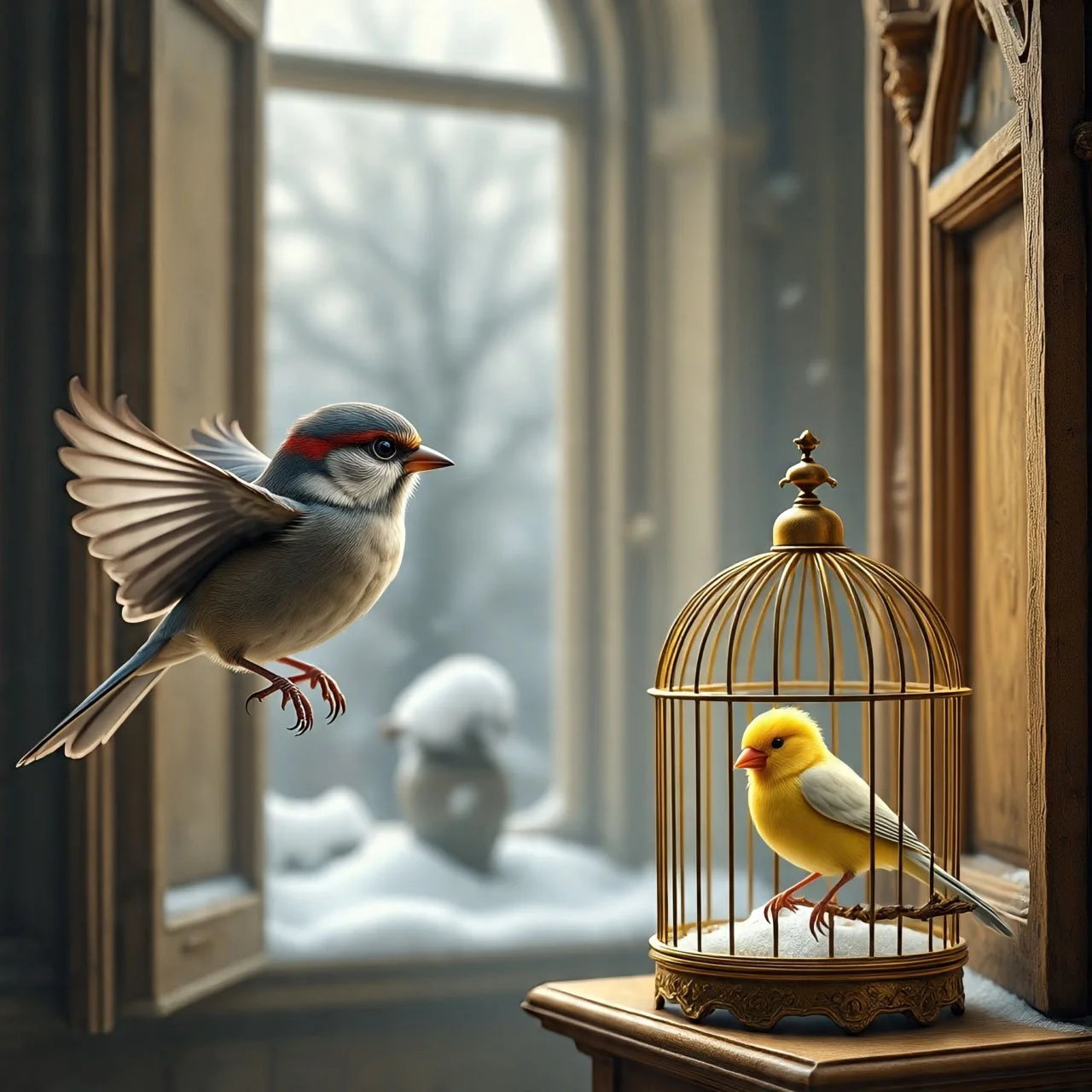
“Goodbye little yellow bird.” #One.
“Goodbye little yellow bird,” she sings. “The snow was very plentiful. And clouds were very few. When a weather-beaten sparrow Through, a mansion window flew. Her eye fell on a golden cage. A sweet love song she heard. Sung by a pet canary there. A handsome yellow bird. He said to her, "Miss Sparrow, I've been struck by Cupid's arrow, would you share my cage with me?" She looked up at his castle, with its ribbon and its tassel, and in plaintive tones said she: “Good-bye, little yellow bird, I'd rather brave the cold. On a leafless tree, than a prisoner be. In a cage of gold. The spoiled and petted yellow bird could scarce believe it true, that a common sparrow should refuse, A bird with blood so blue. He told her the advantages, Of riches and of gold. She answered that her liberties, for gold could not be sold. She said, "I must be going." But he cried "No, no, it’s snowing. And the wintry winds do blow, Stay with me, my little dearie. For without you 'twould be dreary." But she only sighed "Ah, no." "Good-bye, little yellow bird, I'd gladly mate with you. I love you, little yellow bird, But I love my freedom, too. So good-bye, little yellow bird, I'd rather brave the cold. On a leafless tree. Than a prisoner be. In a cage of gold."
The indelible memories of that fateful eve still linger in my mind like the subtle scent of lavender on a summer's breeze. I recounted to my dear friend Harry about the night I first laid eyes on the enchanting Sybil Vane, her presence on stage akin to a radiant comet streaking across the velvet expanse of the evening sky. As I regaled Harry with tales of her ethereal beauty and captivating stage presence, he interjected with one of his characteristic aphorisms: "Never marry at all, Dorian. Men marry because they are tired; women, because they are curious: both are disappointed." His words, laced with the cynicism of a seasoned libertine, brought a wry smile to my lips.
"I don’t think I am likely to marry, Harry… succumbing to the bonds of matrimony won’t be me" I replied with a levity that belied the turmoil brewing within me. “I am too much in love. That is one of your aphorisms. I am putting it into practice, as I do everything that you say.’ Yes. I am in love with Sybil Vane. Your words, as always, are gospel to me, I put into practice all your sage advice." My voice dripped with sarcasm, but Harry knew me too well to be fooled.
Indeed, I am besotted with Sybil Vane, that tender blossom of a girl who has captivated my heart with her artless charm and guileless beauty. Her presence has awakened a maelstrom of emotions within me, a tempest that threatens to consume me whole. And yet, I am powerless to resist her allure, drawn to her innocence and vivacity like a moth to the flame. Ah, Sybil, my love for you is a madness, a delicious torment that I would not trade for all the pleasures of the world.
As I pondered the depths of my infatuation, Harry's words continued to echo in my mind, a bittersweet melody that underscored the futility of my desires. I scoffed at the notion, convinced that my love for Sybil would defy the conventions of society, that our passion would burn bright and true, unencumbered by the weights of matrimony.
But, alas, I was blinded by the radiance of my own emotions, unable to see the precipice towards which I was hurtling. Sybil, with her guileless heart and artistic soul, had awakened a part of me that I never knew existed. Her presence was a catalyst, stirring the stagnant waters of my conscience, and I was both exhilarated and terrified by the prospect of being swept away by the tide of love.
As I strolled through the gardens of my estate, the moon casting a silver glow over the manicured lawns, I couldn't help but think of Sybil's smile, her laughter, her eyes that sparkled like diamonds in the sunlight. I was entranced, ensnared by the silken threads of my own desires. And yet, a nagging voice within me whispered warnings of the dangers of loving so deeply, of surrendering oneself to the whims of another.
But I would not be swayed, for I was Dorian Gray, the golden boy, the darling of society, and I would not be denied. I would have Sybil’s body and soul, and nothing would stand in the way of our love. Little did I know, however, that my portrait, that accursed thing, held secrets and whispers of its own, secrets that would ultimately seal my fate and damn me to a life of unending torment, the night of Sybil’s demise.
“Sybil is a genius”, I assured my dear friend. “My dear boy, no woman is a genius. Women are a decorative sex. They never have anything to say, but they say it charmingly. Women represent the triumph of matter over mind, just as men represent the triumph of mind over morals.” He retorted. “My dear Dorian, it is quite true. I am analyzing women at present, so I ought to know. The subject is not so abstruse as I thought it was. I find that, ultimately, there are only two kinds of women, the plain and the colored. The plain women are very useful….The other women are very charming. And where did you come across her?”
“I will tell you, Harry, but you mustn’t be unsympathetic about it. After all, it never would have happened if I had not met you. You filled me with a wild desire to know everything about life. For days after I met you, something seemed to throb in my veins,” I replied. “I went out and wandered eastward, soon losing my way in a labyrinth of grimy streets and black grassless squares. About half-past eight I passed by an absurd little theatre, with great flaring gas-jets and gaudy play-bills….. I went in and paid a whole guinea for the stage-box. To the present day I can’t make out why I did so; and yet if I hadn’t—my dear Harry, if I hadn’t—I should have missed the greatest romance of my life…..” I stopped as Harry laughed at me. “I see you are laughing. It is horrid of you!” I said unamused.
“I am not laughing, Dorian; at least I am not laughing at you. But you should not say the greatest romance of your life. You should say the first romance of your life. You will always be loved, and you will always be in love with love.…Don’t be afraid. There are exquisite things in store for you. This is merely the beginning…….I think that your nature so deep.”
“How do you mean?” I said curiously.
“My dear boy, the people who love only once in their lives are really the shallow people. What they call their loyalty, and their fidelity, I call either the lethargy of custom or their lack of imagination…….But I don’t want to interrupt you. Go on with your story.”
I said enthusiastically, “Well, I found myself seated in a horrid little private box, with a vulgar drop-scene staring me in the face. I looked out from behind the curtain and surveyed the house. It was a tawdry affair, all Cupids and cornucopias, like a third-rate wedding-cake….and there was a terrible consumption of nuts going on. This play was good enough for us, Harry. It was Romeo and Juliet. I must admit that I was rather annoyed at the idea of seeing Shakespeare done in such a wretched hole of a place. Still, I felt interested, in a sort of way. At any rate, I determined to wait for the first act. There was a dreadful orchestra, but at last the drop-scene was drawn up and the play began. All the players were terrible Harry. I tell you, terrible! But Juliet! Harry, imagine a girl, hardly seventeen years of age, with a little, flowerlike face, a small Greek head with plaited coils of dark-brown hair, eyes that were violet wells of passion, lips that were like the petals of a rose. She was the loveliest thing I had ever seen in my life. You said to me once that pathos left you unmoved, but that beauty, mere beauty, could fill your eyes with tears. I tell you, Harry, I could hardly see this girl for the mist of tears that came across me. And her voice—I never heard such a voice. It was very low at first, with deep mellow notes that seemed to fall singly upon one’s ear. Then it became a little louder and sounded like a flute or a distant hautboy. In the garden scene it had all the tremulous ecstasy that one hears just before dawn when nightingales are singing. There were moments, later, when it had the wild passion of violins. You know how a voice can stir one. Your voice and the voice of Sibyl Vane are two things that I shall never forget. When I close my eyes, I hear them, and each of them says something different. I don’t know which to follow. Why should I not love her? Harry, I do love her. She is everything to me in life. Night after night I go to see her play. One evening she is Rosalind, and the next evening she is Imogen. I have seen her die in the gloom of an Italian tomb, sucking the poison from her lover’s lips. I have watched her wandering through the forest of Arden, disguised as a pretty boy in hose and doublet and dainty cap. She has been mad and has come into the presence of a guilty king, and given him rue to wear and bitter herbs to taste of. She has been innocent, and the black hands of jealousy have crushed her reed like throat. I have seen her at every age and in every costume. Ordinary women never appeal to one’s imagination. They are limited to their century. No glamour ever transfigures them. One knows their minds as easily as one knows their bonnets. One can always find them. There is no mystery in any of them. They ride in the park in the morning and chatter at tea parties in the afternoon. They have their stereotyped smile and their fashionable manner. They are quite obvious. But an actress! How different an actress is!”
I observed Harry with a smile that taunts me.
“Harry! why didn’t you tell me that the only thing worth loving is an actress? I wish now I had not told you about Sibyl Vane.” I continued.
“Because I have loved so many of them, Dorian.” Said Harry. “You could not have helped telling me, Dorian. All through your life you will tell me everything you do.”
I replied, “Yes, Harry, I believe that is true. I cannot help telling you things. You have a curious influence over me. If I ever did a crime, I would come and confess it to you. You would understand me.”
“People like you—the wilful sunbeams of life—don’t commit crimes, Dorian. But I am much obliged for the compliment, all the same. And now tell me, what are your actual relations with Sibyl Vane? I suppose she will belong to you some day. When one is in love, one always begins by deceiving one’s self, and one always ends by deceiving each other. That is what the world calls romance. You know her, at any rate, I suppose?”
The scathing rebuke cut like a razor's edge, its biting words akin to a dash of vitriol splashed upon my countenance. A flush of indignation rose to my cheeks as I sprang from the couch, my movements animated by a sense of wounded pride. "Good heavens, Harry, must you always speak with such brutal candor?" I exclaimed; my voice tinged with the frost of affronted sensibilities. "Can you not temper your words with a modicum of tact, lest you wound the tender feelings of those around you?"
As I stood, my eyes flashed with annoyance, my very posture seeming to convey the depth of my offense. I felt as though I had been skewered by Harry's rapier-like wit, my vanity stung by the lash of his sarcasm. And yet, even as I bristled with indignation, a part of me was drawn to the darkness of his words, the unflinching candor that spoke to the very depths of my own soul.
I paced across the room, my footsteps light upon the Aubusson carpet, as I struggled to compose myself. The fire crackled and spat in the grate, casting flickering shadows upon the walls as I grappled with the turmoil that churned within me. Ah, Harry, with his infernal cleverness and his wicked, probing gaze, seemed to know me better than I knew myself, and it was a disquieting feeling, to say the least. But I would not be cowed, no, not even by the unflinching scrutiny of my dear friend. I would maintain my composure, my dignity, and my mask of innocence, no matter the cost.
“Of course I know her.” I exclaimed. “On the first night I was at the theatre, the horrid old man came round to the box after the performance was over and offered to take me behind the scenes and introduce me to her. “She taken with you sir, say the word and I will take you backstage.” Said he. I was furious with him, and told him that Juliet had been dead for hundreds of years and that her body was lying in a marble tomb in Verona. I think, from his blank look of amazement, that he was under the impression that I had taken too much champagne, or something.” We both laughed uncontrollably.
I continued, “By this time, however, the lights were being put out in the theatre, and I had to go. He wanted me to try some cigars that he strongly recommended. I declined. The next night, of course, I arrived at the place again. When he saw me, he made me a low bow and assured me that I was a munificent patron of art. He had an extraordinary passion for Shakespeare, I thought.”
Harry interrupted, “when did you first speak to Miss Sibyl Vane?”
“The third night. She had been playing Rosalind. I could not help going round. I had thrown her some flowers, and she had looked at me—at least I fancied that she had. The old man was persistent. He seemed determined to take me behind, so I consented.
Oh Harry, she was so shy and so gentle. There is something of a child about her. Her eyes opened wide in exquisite wonder when I told her what I thought of her performance, and she seemed quite unconscious of her power. I think we were both rather nervous. The old man stood grinning at the doorway of the dusty greenroom, making elaborate speeches about us both, while we stood looking at each other like children. He would insist on calling me ‘My Lord,’ so I had to assure Sibyl that I was not anything of the kind. She said quite simply to me, ‘You look more like a prince. I must call you Prince Charming.’
TO BE CONTINUED…..
Note: Many quoted scenes and conversations from the book “The picture of Dorian Gray.” https://www.gutenberg.org/files/174/174-h/174-h.htm#chap04