A most grievous calamity befalls London in the year, 1885.
The esteemed Editor W.T. Stead of The Pall Mall Gazette embarked upon a most noble crusade, seeking to shield young maidens from the ravages of exploitation. He decried the practice of arranged marriages, wherein tender innocents were sold into lives of unmitigated woe, and maiden tributes, which facilitated the downfall of the unsuspecting. The age of consent, a mere thirteen winters, was deemed by many to be woefully inadequate, and the press was replete with articles decrying this state of affairs.
The Pall Mall Gazette itself published a series of sensational exposés, including "The Maiden Tribute," "The Violation of Virgins," "Strapping Girls Down," "The Sale and Purchase and Violation of Children," and "The procuration of Virgins." The notion that a girl of tender years might be deemed fit for marriage or sale by her parents, simply to secure a fortune, was abhorrent to Stead and his supporters. In fact, the age of consent had been set at twelve in the year 1275, and many argued that this was still far too lenient, given the tender age at which girls were capable of bearing children.
The revelatory disclosures that burst forth upon the public consciousness compelled the inhabitants of London and the parliamentary dignitaries of the realm to elevate the age of consent to sixteen winters. Alas, no corresponding provision was made for the male youth of the nation. The Criminal Law Amendment Act of 1885, a legislative endeavor of considerable import, devoted itself to the safeguarding of children and the protection of young women from the perils that beset them. Meanwhile, males, once attaining a certain age, were left to navigate the complexities of life unassisted, enjoying either the harsh liberty of fending for themselves or the privileged prerogative of living their lives unencumbered by governmental oversight.
Prior to the enactment of this statute, carnal knowledge of a female above the tender age of thirteen was deemed consensual, and the parties involved would be dispatched to the ecclesiastical authorities to solemnize their union in matrimony. Numerous families, particularly those of limited means, would oftentimes relinquish their daughters to wedlock with gentlemen considerably older and of greater financial standing, solely due to their own pecuniary inability to provide for their child's well-being.
Advocates for women's rights, such as the indefatigable Josephine Butler, had zealously campaigned for an elevation of the age of consent to eighteen or twenty-one, positing that females beneath these ages were still in a state of mental and emotional childhood. Conversely, those who argued in favor of maintaining the status quo of thirteen winters as the age of consent averred that many a young woman from the lower classes, particularly in districts such as the East End; presented an appearance and demeanor belied their tender years. To elevate the age of consent, they contended, would expose unwary gentlemen to the risk of blackmail, particularly in instances where the females in question appeared and comported themselves in a manner inconsistent with their youth. It was a lamentable truth that poverty had a tendency to prematurely age both boys and girls, whereas the scions of the elite were indulged in debutante balls, a stark contrast to the harsh realities faced by those less fortunate.
In accordance with the common law of the land, a male child beneath the tender age of fourteen winters was deemed incapable of perpetrating the heinous crime of rape, thereby absolving him of culpability. Consequently, the legal framework remained mute on the matter of boys' capacity to consent to carnal knowledge, a stark contrast to the safeguards afforded to girls. This disparity conferred a certain privilege upon males, whether boys or men. However, the law did take cognizance of "gross indecency" between males, thereby effectively proscribing all manner of same-sex congress, irrespective of age.
Those who engaged in such practices were oft referred to as "Bacchá". Noteworthy individuals, such as John Saul, a celebrated male prostitute of the Victorian era, found themselves embroiled in scandalous affairs, notably the Dublin Castle scandal of 1884 and the Cleveland Street Scandal of 1889. Males who had attained the age of fourteen summers were deemed capable of partaking in the fruits of adulthood, provided they did not indulge in same-sex dalliances. One might ponder whether such laws were grounded in moral principle or designed to safeguard young girls from exploitation, whilst leaving boys vulnerable to predation.
The year 1885 was likewise marked by a new statute which presented a direct threat to many gentlemen, including those who sought to conceal their unconventional leanings through the shelter of marriage, much as Mr. Oscar Wilde had himself done.
Furthermore, the Criminal Law Amendment Act of 1885 made "gross indecency" between men a crime punishable by up to two years of hard labor, a crime to which Oscar could not stop himself from committing and succumbed to in later years. The new law forced homosexual men to become more secretive and live a double life to avoid legal action. It is known that many gentlemen of marriageable age, our Oscar included, would take a wife and acquit themselves honorably of their marital duties, only to thereafter plunge into the deeper, veiled joys of the flesh with other men. Could one say that this atmosphere of fear and secrecy made me who I am? To hide my true nature from society, yet displayed in grandeur in London’s East End? Consequently, destroying the fabric work of my portrait.
In subsequent years, following Wilde's demise, societal mores underwent a significant transformation, particularly amongst our American cousins, as we entered the Edwardian era. A considerable amount of speculation arose regarding Wilde's personal inclinations, specifically with regard to his relationships with young men. The law of the time did not provide clear guidance on the matter, leading to much debate and conjecture.
My descent into debauchery led Oscar and I to the East End of London, where we indulged in the darker aspects of life, surrounded by poverty, crime, and moral decay. Sneaking away from my luxurious world, donning disguises to blend in with the crowds, and immersing myself in the seedier side of town, did come unnoticed. I was a none married man with many debutante ladies at my disposal, yet I was not suspected. The East End's cramped alleys, dimly lit streets, and raucous music halls became my playground, where I could shed my aristocratic persona and give in to my baser desires. I would frequent opium dens, where the air was thick with the smoke of pipes and the morals were as hazy as the atmosphere. I would rub shoulders with thieves, prostitutes, and con artists, finding a twisted sense of belonging among those who, like me, lived in the shadows. Only I, amongst a very few, had the luxury of going back to my gilded castle, unsuspected of vile things. I was the best con artist of them all.
You could say that my acts in the East End were those of a man consumed by his own vanity and selfishness, with no regard for the consequences of his actions or the lives he touched. Could you blame me? The portrait that Basil painted of me drew me to such end, because of my idea of immortality. Nothing could touch me. Not rumors and not even the law of 1885.
I would lure not innocent young men from the streets, promising them a life of luxury and excess, only to discard them when they no longer amused me, because they would have done the same if the table were turned. Victorian London is about putting one’s need first, especially amongst the people of the East End. Underground boxing matches, tickle my fancy, where I would bet on the outcome, and watch with a mixture of fascination and disgust. When I wasn’t satisfied, I would take into the streets and alley way, to make the youth fight for a shilling.
Though my presence in the East End was a whispered rumor among the locals, who spoke of a mysterious figure, known only as “The Gentleman”, who would appear and disappear without warning, leaving a trail of destruction and heartache in his wake’. Few knew my identity, but all knew to steer clear of him, for “The Gentleman” was a man without a conscience, driven solely by his own desires, and stopped at nothing to satisfy them.
Blackmail!
One man in particular who fell to this, was Alan Campbell.
Places like the "Black Lion" pub, and Ten Bells, notorious for its bare-knuckle fights and shady clientele, or the "Midnight Rose" brothel, whose madam catered to the most depraved tastes of London's elite. I attend secret gaming dens hidden behind innocent-looking shop fronts, where fortunes were won and lost on a single roll of the dice. That establishment and area known for both its criminal reputation, with the Jack the Ripper murders and the fear of The Gentleman. I daresay, I often ponder whether our paths may have crossed with that notorious figure, Jack. Might I have shared a tankard of ale or a meal with him, or perhaps partaken in the hazy indulgence of opium dens in his company? I must hasten to clarify that I am not suggesting any direct connection between myself and the infamous individual, for speculation ran rampant regarding his likeness, whereas mine remained notably absent from such conjecture.
My charm and wealth granted me access to the most exclusive and illicit events in the East End. I would receive private invitations to masquerade balls hosted by anonymous patrons, where the guests wore elaborate costumes and masks to conceal their identities. These events often devolved into orgies of drinking, dancing, and other vices, with yours truly usually at the center, indulging at every whim.
I drew near to one establishment in time and again; a small, unassuming shop in Whitechapel called "Curios and Antiques". The store's proprietor, an eccentric old man with oily, tremulous smile, named Mr. Isaac, dealt in rare and unusual items, many of questionable origin. I later found out that Mr. Isaac also managed the Holborn (The two turtles), a low-class and wretched place, where my love Sibyl Vane made her theatrical appearance, to which he introduced me to her. “I’ll gladly introduce you sir, but she is proud, she won’t meet anybody” and “she’s taken with you sir. Say the word and I will take you backstage”. Such words, so cunningly manipulative, would surely serve only to heighten my desire for an audience with her.
After Lord Henry’s liking of Mr. Isaac, which gave me permission to tolerate him. I quickly found myself fascinated by the strange artifacts on display. Ancient relics, taxidermized creatures, and occult symbols etched into stone or wood. Spending hours browsing the shelves, engaging in conversation with Mr. Isaac, who seemed to sense the darkness lurking beneath my polished exterior. Their discussions often turned to the supernatural and occult, topics that both repelled and attracted me in equal measure.
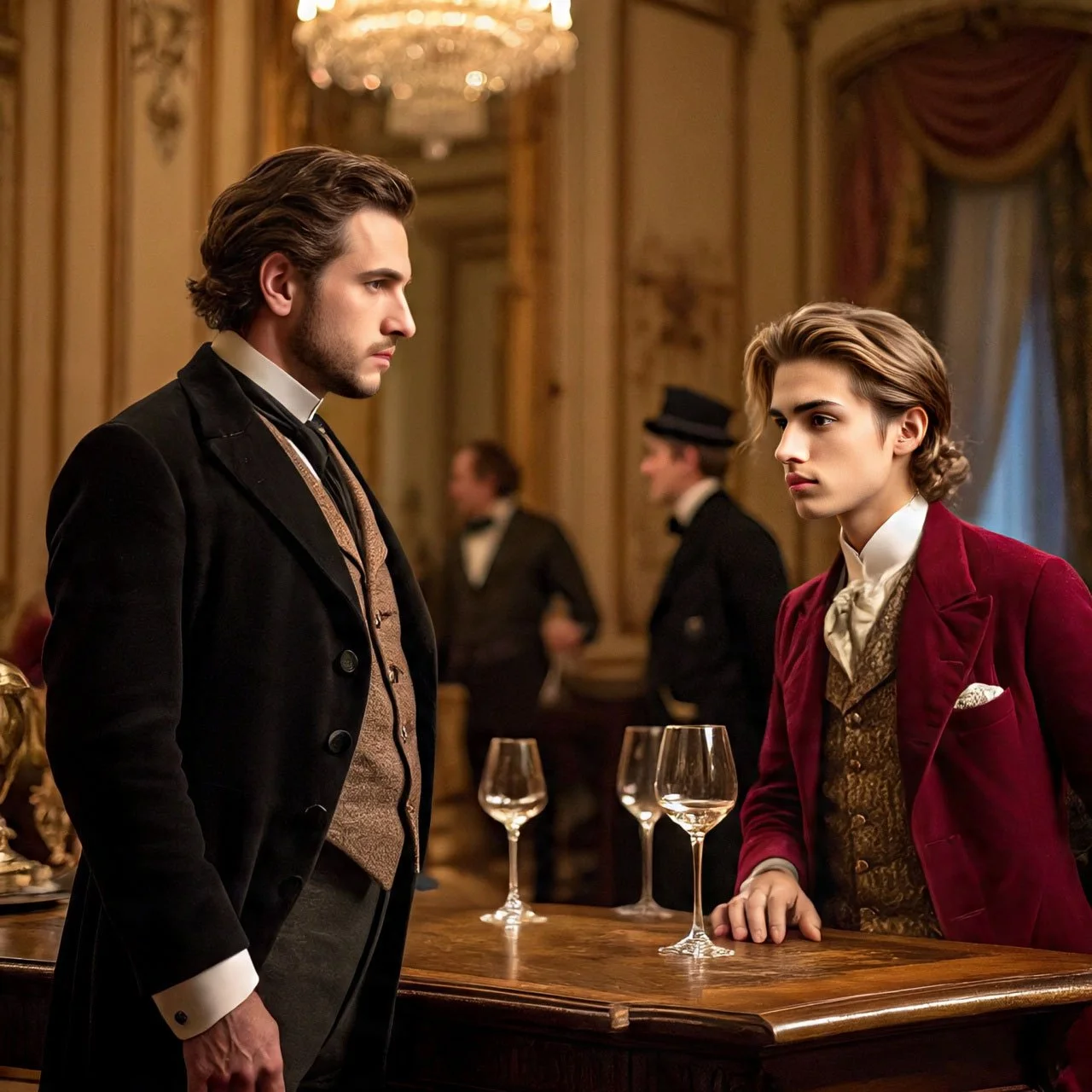
Young Dorian and Basil Hallward meets.
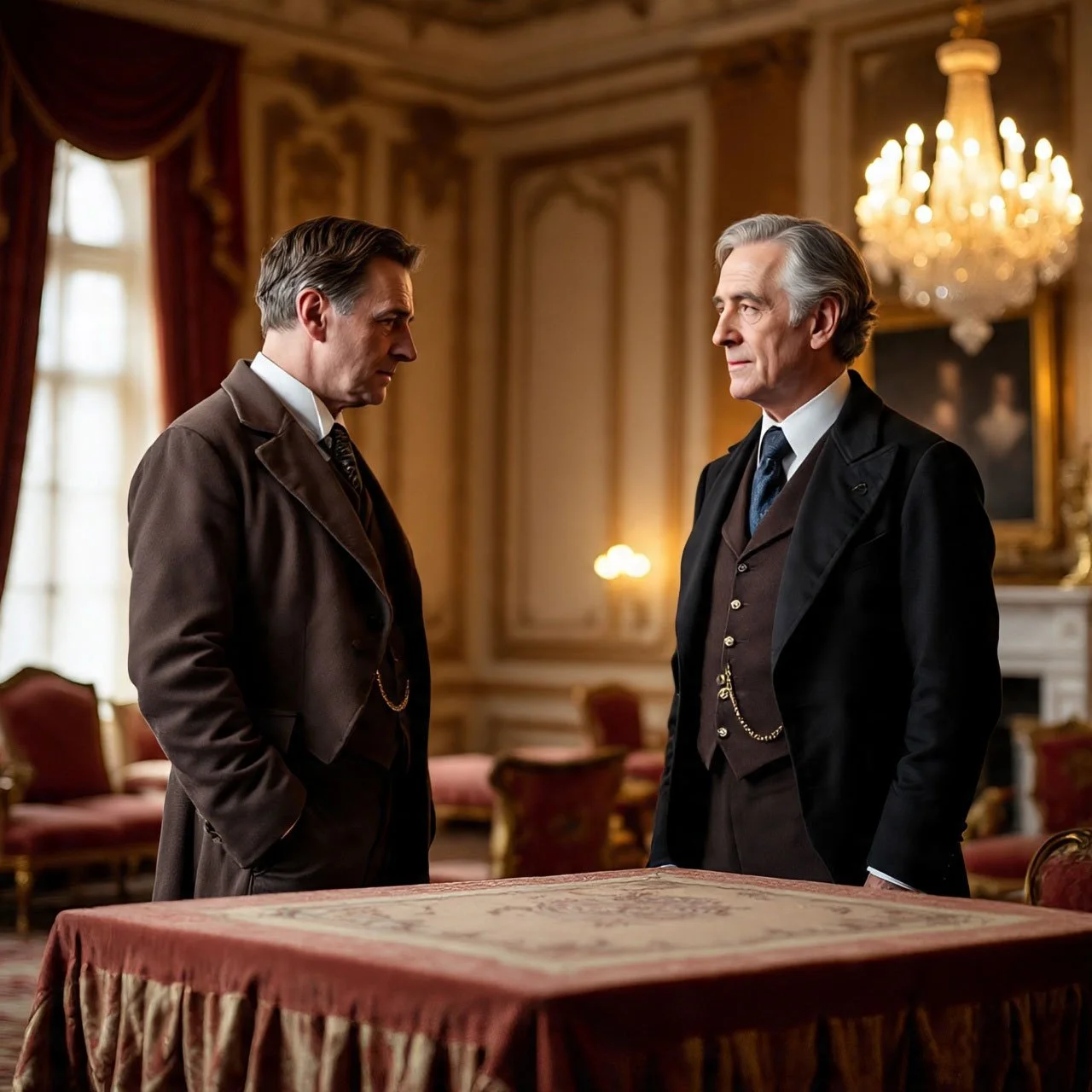
Years have gone by. Lord Henry Wotton and Basil Hallward.